Understanding the Left Ventricle Two-Chamber View: Comprehensive Cardiac MRI Planning for Technologists
- cardiacmrihub
- Nov 22, 2025
- 4 min read
Updated: Dec 1, 2025
LV 2-Chamber View in Cardiac MRI: Planning & Protocols
2 Chamber Planning
Master left ventricle two-chamber (2ch) view imaging in cardiac MRI. Learn essential planning techniques for anterior and inferior wall assessment and complete ventricular function evaluation.


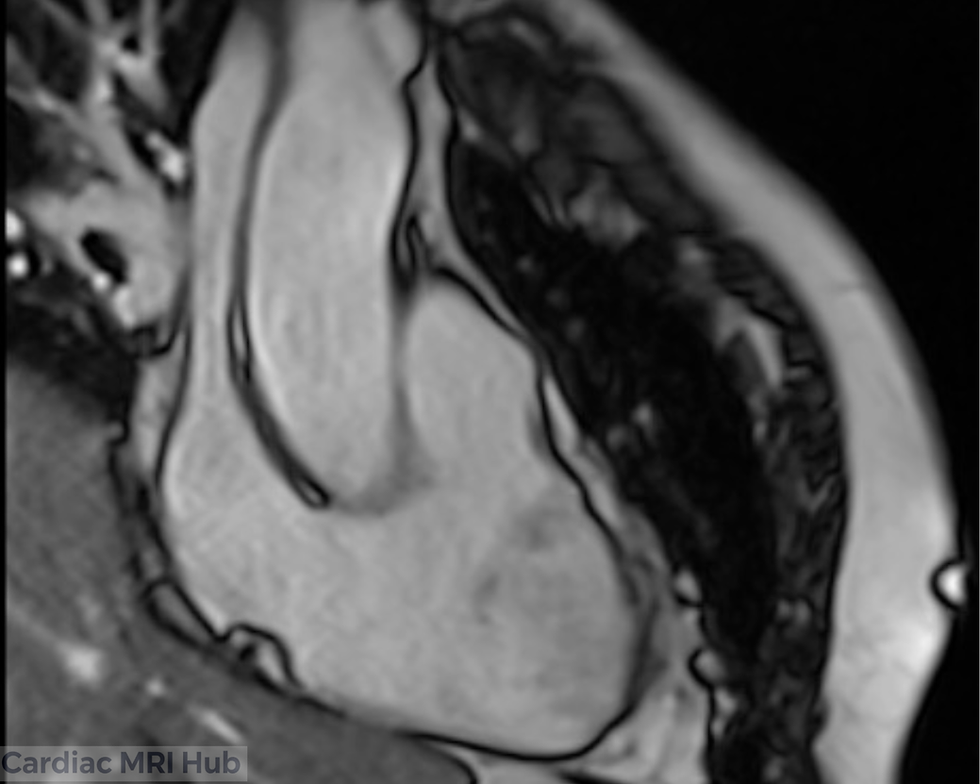
Overview: The left ventricular two-chamber (LV 2ch) view is fundamental in cardiac MRI, offering focused imaging of the left atrium and ventricle, as well as the mitral valve and adjacent myocardial walls. This plane supports precise quantification and detailed assessment, especially for ischemia, infarction, and advanced tissue characterization.
1. Purpose and Clinical Value
Functional Assessment
Quantitative evaluation of regional LV function, ejection fraction, and wall motion.
Crucial for identifying specific patterns of wall motion abnormality in ischemic or non-ischemic cardiomyopathies.
Valvular Evaluation
Direct visualization of the mitral valve for morphology and competence.
Enables assessment of mitral regurgitation jets, prolapse, or stenosis using cine and phase-contrast imaging.
Tissue Characterization
Ideal for mapping subendocardial and transmural scars in infarct imaging and fibrosis detection.
Provides a longitudinal view for LGE, T1/T2 mapping, and perfusion studies.
Disease Monitoring
Serial imaging for progression of conditions such as myocarditis, hypertrophic cardiomyopathy, or post-therapy remodeling.
2. Planning and Acquisition Techniques
Orientation and Planning
LV 2ch view should bisect the mitral valve and extend through the LV apex, parallel to the interventricular septum and the long axis of the LV.
Cross-reference using 4-chamber and short-axis views to minimize foreshortening. Accurate plane ensures reproducible measurements and diagnostic clarity.
Patient Positioning & Immobilization
Supine position with arms appropriately positioned to minimize coil artifact.
Ensure breath-hold capability—practice with patients prior to scanning if possible.
Slice Thickness & Resolution
Cine imaging: 6–8 mm slices optimize resolution and SNR.
High-resolution or late enhancement: <6 mm slices preferred for tissue characterization (e.g., LGE/Fibrosis).
Field of View (FOV)
Standard adult FOV: 280–350 mm, tailored to body habitus.
Ensure full LV length and LA inclusion, avoiding excess tissue outside the region of interest.
Timing and Synchronization
Retrospective ECG gating recommended to capture full cardiac cycle (25–30 phases/cycle).
For tissue characterization, target mid-diastole or best phase for reduced motion.
Common Pitfalls
Check alignment with 4ch and short axis views to ensure the 2ch plan is parallel to the interventricular septum.
Avoid partial volume or wrap artifacts, ensure proper alignment with 4ch.
For patients with arrhythmia or poor breath-hold capability, be ready to use real-time (non-gated or compressed sensing) cine sequences and adapt your protocol accordingly.
3. Advanced Contrast and Tissue Characterization
Gadolinium-Based Contrast
LGE sequences post-contrast visualize infarction, fibrosis, and infiltrative disease.
Precise timing (7–15 minutes post-injection) and optimized inversion recovery are crucial for visualizing myocardial scarring.
Supplementary Imaging
Consider T1, T2, and extracellular volume mapping for in-depth tissue characterization, especially for myocarditis or infiltrative disorders.
4. Troubleshooting and Optimization Tips
Imaging Artifacts
Motion: Use respiratory gating for challenging breath-holds or free breathing with motion correction algorithms.
Arrhythmias: Adaptive gating/arrhythmia rejection or single-shot sequences may help. Applying compressed sensing if available, may be beneficial.
Coil Placement: Isocenter the coil on heart for highest SNR, utilize multiple coil arrays for improved signal.
Realtime Monitoring
Continuously monitor ECG signal for gating; address poor R-wave detection promptly (skin prep, lead repositioning, or change leads).
Communicate with the patient throughout to ensure comfort and minimal movement.
Protocol Customization
Collaborate with radiologists for case-specific needs, especially complex congenital heart disease.
Adjust slice number, thickness, and imaging sequences based on the clinical indication and patient's tolerance.
5. Post-Processing and Analysis
Volumetric and Functional Analysis
Use advanced software to calculate volumes, function, and wall motion.
Precisely quantify LV mass, LA size, and infarction extent.
Reporting
Standardized templates improve consistency; include chamber sizes, function, and any abnormal findings (e.g., hypertrophy, delayed enhancement).
6. Clinical Scenarios and Pearls
Left Atrium
Enlargement: Marker for heart failure or AFib.
Evaluate diastolic dysfunction via LA pressure changes and morphology.
Left Ventricle
Regional wall motion: Identify ischemic segments or infarct zones.
Scar detection: Guide therapy for arrhythmia and post-MI management.
7. Educational Takeaways and Best Practices
Planning Precision
Mastery of LV 2ch view planning ensures diagnostic reliability and supports advanced disease analysis.
Protocol Adaptation
Tailor technique for each patient and clinical indication; one size does not fit all.
Team Collaboration
Collaborate closely with radiologists and referring clinicians to understand clinical questions and improve scan protocols.
Summary Table: Essential Parameters for LV 2-Chamber Planning
Parameter | Recommendation (Adult) |
Orientation | Bisect mitral valve & LV apex, long-axis plane |
Slice Thickness | 6–8 mm with or without 2-4mm gap (to make total of 10mm), LGE: Same thickness as cine. |
Field of View | 280–350 mm, adjusted to patient. |
Phase Oversampling | Adjust to patient/FOV to avoid wrap. |
Temporal Resolution | 45ms or less preferred (Real-time 60ms or less) |
Resolution | 1.4–1.8mm preferred. |
Bandwidth | Wide: 750-1300 Hz/Px (Higher reduces artifacts) |
Flip Angle | 40–90 (CINE), 20–25 (LGE) |
Parallel Imaging | GRAPPA 2 |
Compressed Sensing | Use when available to reduce acquisition time and motion artifacts, especially useful in patients with poor breath-hold or arrhythmia. |
Contrast | Gadolinium for LGE 10 mins post (delay timing will depend on dose and if stress/rest perfusion performed). Precise timing of TI needed to null myocardium |
Immobilization | Supine, coil centered over heart. |
Breath-hold | 8-12 sec preferred. |
Conclusion: Mastering the planning of the LV 2-chamber view enhances the diagnostic capability of cardiac MRI. Combine detailed anatomical knowledge with protocol customization to deliver optimal patient care and outcomes. Empower your facility with precision, adaptability, and advanced understanding.


Comments