Left Ventricle Quick Plan
- cardiacmrihub
- Nov 8, 2025
- 4 min read
Updated: Dec 1, 2025
Cardiac MRI of the Left Ventricle
This section outlines a structured approach for planning cardiac MRI specifically for assessing the left ventricle. Key components include:
Critical Views
Four essential views are highlighted for thorough evaluation:
Two-Chamber View: Assesses anterior and inferior walls.
Four-Chamber View: Evaluates overall function and structure of the left and right ventricles and atria.
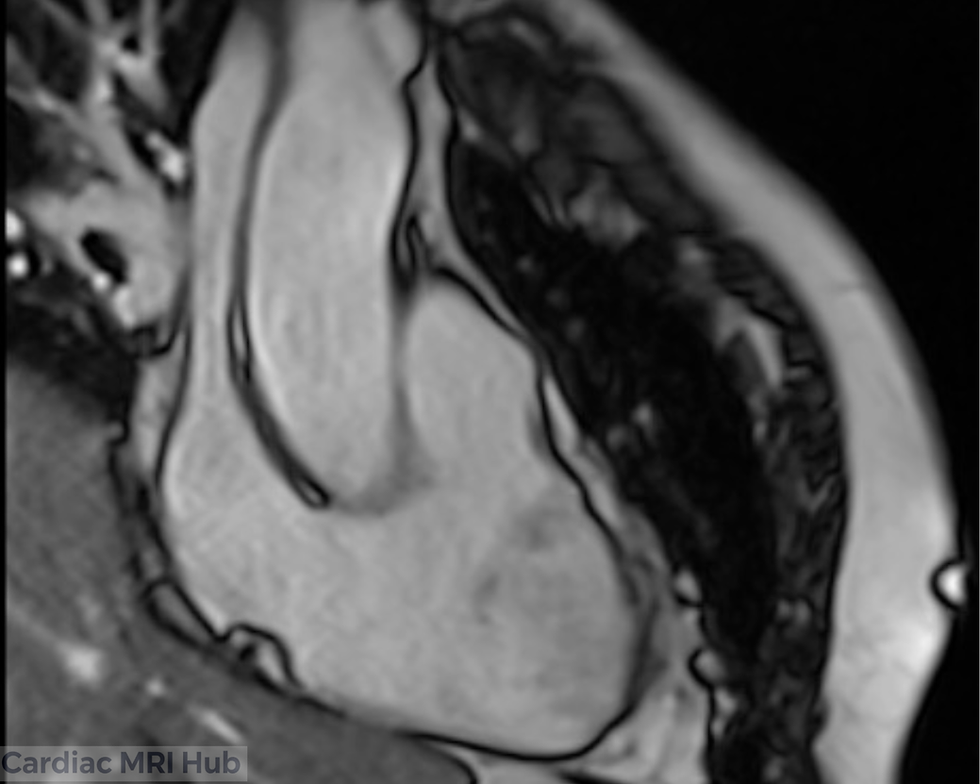
Three-Chamber View: Focuses on the left ventricular outflow tract and aortic valve.
Short-Axis Views: Analyzed at basal, mid, and apical levels for wall motion and thickness.
Image Acquisition Techniques
Key techniques for optimal imaging include:
Sequence Selection: Cine imaging for assessment of cardiac motion, structure, and morphology; late gadolinium enhancement for myocardial scarring.
Slice Thickness and Spacing: Typically 6-8mm slice thickness with no gap; adjust based on patient size and clinical indication to balance resolution and scan time.
Timing of Acquisition: ECG gating during diastole for image clarity.
Post-Processing Techniques: Utilization of 3D reconstruction for enhanced analysis and interpretability.
Planning Steps
Essential steps for effective planning involve:
Patient Preparation: Ensure understanding of the procedure.
Positioning: Comfortably position the patient supine.
Imaging Parameters: Set to achieve optimal quality.
Contrast Administration: Administer safely according to site policy.
Monitoring: Continuously check the patient's condition during exam.
Effective planning and execution of these steps enhance the diagnostic capabilities of cardiac MRI for the left ventricle, improving patient management.
2 Chamber Planning


Left Ventricle Two-Chamber View Planning
The two-chamber view of the left ventricle in cardiac MRI provides essential insights into the anatomy and functionality of the left atrium and left ventricle, allowing detailed assessment of their structure and potential abnormalities.
Key Considerations for Planning
Orientation: Obtain from a plane slicing through the left atrium and ventricle for clear visualization.
Field of View: Capture the left atrium and ventricle without missing critical structures.
Clinical Applications
Evaluate left ventricular size and function.
Assess left atrial dimensions and morphology.
Identify structural heart disease.
Monitor left ventricular hypertrophy or dilation over time.
Key Features of the Two-Chamber View
Left Atrium: Analyze size and structural abnormalities.
Left Ventricle: Assess volume, wall motion, and cardiac function.
3 Chamber Planning


Pictures to right and left showing orientations on 2ch & 4ch for the left ventricular 3ch.
Left Ventricle Three-Chamber View Planning
The three-chamber view in cardiac MRI provides critical insights into the heart's anatomy and function, including the left atrium, left ventricle, and aorta, aiding in the assessment of cardiac conditions.
Key Considerations for Planning
Orientation: Align the plane with the left ventricle and aorta for optimal visualization of the outflow tract.
Field of View: Include the left ventricle, left atrium, and proximal aorta.
Clinical Applications
Evaluate left ventricular function and wall motion.
Assess mitral valve function and morphology.
Identify left atrial enlargement.
Monitor conditions like hypertrophy or ischemia.
Key Features of the Three-Chamber View
Left Atrium: Assess size and abnormalities.
Left Ventricle: Evaluate volume, wall motion, and function.
Aorta: Examine the aortic root and proximal aorta.
4 Chamber Planning


Left Ventricle Four-Chamber View Planning
The four-chamber view in cardiac MRI is crucial for assessing the heart's structure and function, covering the left and right atria and ventricles for a comprehensive evaluation of cardiac conditions.
Key Considerations for Planning
Orientation: Obtained from a plane bisecting the heart to show all chambers and the inter-ventricular septum.
Field of View: Should include both ventricles and atria.
Clinical Applications
Assessment of cardiac function and chamber sizes.
Evaluation of valvular heart disease.
Identification of congenital heart defects.
Monitoring cardiac conditions over time.
Key Features of the Four-Chamber View
Left Atrium: Analysis of size and morphology.
Left Ventricle: Evaluation of volume, wall motion, and function.
Right Atrium: Assessment of size and abnormalities.
Right Ventricle: Examination of size and function.
Short Axis Planning


Left Ventricle Short Axis View Planning
The short axis view of the left ventricle in cardiac MRI is essential for assessing heart structure and function, focusing on myocardial characteristics and wall motion.
Key Considerations for Planning
Orientation: Acquired perpendicular to the long axis for optimal visualization of ventricular walls and papillary muscles.
Field of View: Should encompass the entire left ventricle and adjacent structures.
Clinical Applications
Assessing left ventricular function and wall motion abnormalities.
Evaluating myocardial ischemia and scar tissue.
Identifying hypertrophic cardiomyopathy and other structural diseases.
Monitoring cardiac condition changes over time.
Key Features of the Short Axis View
Ventricular Walls: Evaluates wall thickness and motion.
Left Ventricular Volume: Assesses end-diastolic and end-systolic volumes.
Papillary Muscles: Examines morphology and position.
Myocardial Perfusion: Analyzes perfusion defects.
Short Axis Sample (Base Mid Apex)

Short Axis Left Ventricle: Sample (Base Mid Apex)
Short Axis View Alignment
The short axis view, aligned perpendicular to the left ventricle's long axis, is vital for assessing its structure and function at different levels:
Base: Captures the inflow tract and mitral valve, providing insights into the left atrium and aortic outflow tract.
Mid: Evaluates overall left ventricle function, including wall motion and thickness.
Apex: Focuses on the apex for detailed assessment of regional wall motion and potential ischemic changes.
Coronal Aortic (LVOT) Planning


Coronal Aortic Left Ventricular Outflow Tract Imaging
The coronal view of the left ventricular outflow tract in cardiac MRI is vital to diagnosing conditions like aortic stenosis and valvular disease.
Key Considerations for Imaging
Orientation: Align the imaging slice to intersect the aorta at its root for effective visualization.
Field of View: Ensure it covers the entire outflow tract and ascending aorta.
Clinical Applications
Evaluate outflow tract and aortic valve function.
Assess aortic stenosis and regurgitation.
Identify congenital anomalies.
Monitor aortic or valvular conditions.
Key Features of the Coronal View
Left Ventricular Outflow Tract: Examine dimensions and morphology.
Aortic Valve: Assess structure and function, noting calcification, regurgitation, or stenosis.
Ascending Aorta: Check for dilation or abnormalities.
Surrounding Structures: Analyze adjacent structures like the pulmonary artery and left atrium.


Comments